
Thank you to everyone who has submitted questions so far! These are the questions we responded to at the Q&R events, so check them out for more information on the pastoral transition.
You can continue to ask questions any time. We'll respond directly back to you with responses and possibly add more FAQs for everyone else, too!
And be sure you've already read the FAQ Round 1 before digging in here.
Functions/Roles/Structure of the Pastoral Leadership Team
What is actually changing? It seems like we have already been doing this for some time.
This has been a gradual, multi-year transition and we believe we’re continuing down the path God has always set for VCC. To understand what’s actually changing, it helps to look at how leadership and decision-making has shifted over time already.
VCC was founded as a senior pastor-led church where the responsibility for vision and direction rested solely with the senior pastor. The church trusted God to lead David, and the congregation followed his leadership. Over time, David realized he needed a leadership group to support and guide his work (the Pastoral Council). In recent years, the Pastoral Council became functionally team-oriented. While we still had a senior pastor, the team as a whole held decision-making responsibility.
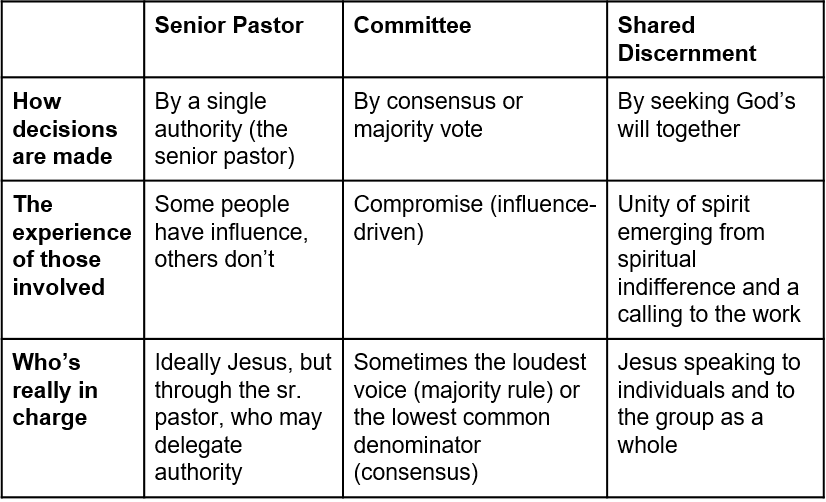
We are now moving to a Pastoral Leadership Team that goes beyond the Pastoral Council because the PLT’s primary goal will be to equip the whole church body to carry out our mission through shared discernment. As this happens, we’ll have less top-down decision-making and delegation driven by one person or a single team and more of Jesus directly leading all parts of the body.
The chart below illustrates how a shared discernment approach differs from senior pastor or committee-driven approaches to decision making.
The installation on July 18 marks an important step. We feel Jesus inviting us to draw a line in the sand: to cross over from discovering shared discernment and then testing it out over the past couple of years to now fully committing to its practice as our way forward.
We view all of the stages we have gone through as part of God’s plan and gifts for our church and we are grateful for them just as we are excited for what’s next!
In our previous leadership structure, our Senior Pastor had the support and counsel of the Pastoral Council. Will the Pastoral Leadership Team have support and counsel in some way built in?
Yes! The vision for the Supporting Group came from something we’ve seen in other ministry organizations where there is a team dedicated to praying together with a formal rhythm for a specific ministry. In our case, we sense this will develop as its own discernment group so it can listen to what Jesus has for the holistic spiritual and emotional support of the Pastoral Leadership Team members and provide counsel and guidance to them as needed. The PLT will have a high degree of trust in the people asked to be part of the Supporting Group.
In addition, the function of the staff team has evolved substantially in recent years. In the past, the church operated primarily with individual volunteer heads of ministry areas and the role of staff was to provide administrative assistance. As we have progressed in this pastoral transition and leaned into shared discernment, the staff is gaining experience with participating in and facilitating shared discernment. The members of the Pastoral Leadership Team have and will continue to rely on the staff to hear from Jesus and speak into many different topics that arise in the church.
The members of the Pastoral Leadership Team also meet together monthly for personal connection and care apart from the work of ministry.
In the Senior Pastor model, it’s clear who to go to if you have concerns, questions, want counseling, or even to officiate a wedding or a funeral. Between the three of you, who do we go to for what?
You can bring any question, concern, or request to any member of the Pastoral Leadership Team. Sometimes there will be the need for more definition on who amongst the PLT should know or be involved, but in general the PLT will discern together how best to approach each situation. Thankfully we have many resources available both within the church and outside of the church such as professional counseling/therapy and spiritual direction. As we live in this new reality, we’ll learn what works best together as a community.
About Shared Discernment:
When you talk about “Shared Discernment,” I’ve heard you use a lot of different words and phrases. Can you provide some definitions?
We would love to! Here’s a quick introduction to some core terms we use as we learn to listen to Jesus together.
Discernment: Asking, “God, what are you doing in this situation, and how can I get on board with it?
Shared Discernment (Discerning Together): A group process where we collectively ask God what He is doing, sharing what we sense, and carefully listen to the Holy Spirit with and through one another. Together, we find common threads that reveal the specific invitation of Jesus and a unified way forward.
Covenant: An agreement defining how a group commits to behave as they work toward a common goal. Covenants are put in place when "what is at stake is so important that we dare not leave the relationship up to chance, passing whims, or misunderstanding."(1) In a shared discernment community, covenants name the group's shared values and practices, giving definition to how they will follow God together to accomplish the work God has given them instead of relying on varying assumptions and unspoken expectations. Covenant making and keeping thereby becomes a spiritual practice that opens us to God's transforming presence and power and becomes a very clear way to help move each other towards Jesus. You can see the Transition Team’s covenant here as an example.
Spiritual Consolation: “This describes the feelings that move us toward God and others. Consolation is any felt increase in faith, hope, and love that leads to holy peace. It is commonly experienced as feelings of peace, serenity, and joy. But spiritual consolation also includes feelings of sadness about circumstances and personal shortcomings as long as these lead to a resolve to draw closer to God. Consolation feels like coming home to God.”(2)
Spiritual Desolation: “Anything that takes us away from love of God and others. It is commonly experienced as a troubled spirit: anxiety, restlessness, doubt, upset. It sometimes includes feelings of pride and smugness about a life centered on pleasure. One of the surest signs of desolation is spiritual lethargy. Desolation points us away from God. Desolation feels like having lost our way home.”(2)
Spiritual Formation/Transformation: The lifelong process of Christ being formed within us for the glory of God, for the abundance of our own lives, and for the sake of others. “The possibility that human beings can be transformed to such an extent that they image Christ is central to the message of the gospel and therefore it is central to the mission of the Church. Spiritual transformation in the lives of redeemed people is a testimony to the power of the Gospel and results in an increasing capacity to discern and do the will of God (Romans 12:2).”(3)
1 Quote from Ruth Haley Barton in Pursuing God’s Will Together
2 Quoted from J. Michael Sparough, SJ in What’s Your Decision?
3 Quoted from Ruth Haley Barton on the Transforming Center web site
Shared discernment seems to require a lot of time. How do we ensure it is accessible and inclusive across all areas of the church?
We’ve committed to this approach to "do church" precisely because it is inclusive. When we first investigated it, we knew that if shared discernment cannot work for everyone who wants to participate, it is not for us as a church.
Actively following Jesus is accessible to all Christians. Ignatius of Loyola helped radically simplify this practice by teaching that only one thing is truly necessary to discern well: love God first. When you know God loves you, making decisions stops being a stressful chore and becomes a regular cue to move closer to Jesus.
As finite humans, we do have limited time and energy to put toward discernment. However, shared discernment is highly flexible and can be calibrated based on the weight/impact of the decision and the spiritual maturity of the person or group seeking God together. These factors, along with God’s timing for each next step, dictate the pace of each decision. Not every choice requires an intense, lengthy process, but every situation can benefit from the principles of shared discernment.
Ultimately, this is more than a decision-making model. It is a daily posture of life. God is an unstoppable doer of good things, and He invites us to co-labor with Him. The true gift of this process is not just a final decision or a successful result. The gift is learning to live out our union with Jesus together, being transformed by Jesus in every part of our lives.
The book Pursuing God’s Will Together focuses on high-level leadership decisions. Why are we moving the whole church this direction instead of just the leadership team?
When our Leadership Structure Assessment Team (LSAT) first read Pursuing God’s Will Together, our strong value on “everybody gets to play” strongly influenced how we read the book: none of us ever considered that it would only be “for the leaders.” On reflection, we can see God planted in us the assumption that if this was what he wanted for us, then it would include everyone. This direction has been repeatedly confirmed over the last few years including by our mentor David Hughes from the Transforming Center (the ministry founded by the book’s author, Ruth Haley Barton).
Jesus cares about how we spend the whole of our lives and speaks to us when we learn to listen. This is a central endeavor for every Christian, not just those with leadership titles within the church. The beauty of shared discernment is that it does more than guide major decisions; it disciples us and brings us closer to one another, moving everyone closer to Jesus.
The Members of the Pastoral Leadership Team
How were the members of the Pastoral Leadership Team determined and how will membership decisions be made going forward? Are there term commitments and what happens if one of you gets called to move away?
All Transition Team and Pastoral Council decisions regarding the PLT members have been made through the shared discernment process. The Transition Team’s work on these decisions has been our most extensive and robust shared discernment process thus far and we’ve gained many invaluable insights along the way.
The Transition Team discerned that equipping the whole church in shared discernment should be of primary importance.. This led to their initial proposal to establish an interim leadership group whose sole purpose would be to equip the church. Emily, Dannielle and Caleb were three leaders with the most experience in this area, so they were asked to personally discern their own involvement in that interim leadership group. When all three agreed to step into that group, the Transition Team then brought in the Collaborators, a group drawn from the staff, board, and heads of ministry, to enter into the shared discernment process. After a very helpful process with the Collaborators, the collective group realized that in order to best equip the church in shared discernment, establishing long-term (not interim) pastoral leadership was the most important first step. Further discernment by the Collaborators, Transition Team, and each individual confirmed the formation of the new Pastoral Leadership Team consisting of Emily, Dannielle, and Caleb.
Potential changes to the membership of the Pastoral Leadership Team going forward will be held with the same strong commitment to seeking God’s will through shared discernment. There are no preset timelines for changes. As the Pastoral Leadership Team forms, the team will develop and commit to a covenant that includes an understanding of how to process both onboarding and offboarding of members. From our understanding of shared discernment, the team is committed not to make unilateral decisions even for each individual’s own participation but instead to genuinely and openly seek God together. Final decisions will be made in unity with the Board.
How will members of the PLT prioritize sustaining their whole-being health as they step into these new roles? What outside support and resources (such as from Vineyard USA) are available?
The first priority of shared discernment is spiritual formation of each individual. Our commitment to this approach is therefore a commitment first to practices that transform our leaders as whole, integrated humans (emotionally, physically, and spiritually). We believe what God calls us into will always ultimately be for the good of everyone involved, including those carrying greater responsibility.
The members of the Pastoral Leadership Team have long-established practices such as daily examen, rhythms of silence and solitude, reflection on Scripture, secure and authentic relationships, and Sabbath-keeping just to name a few. In addition, each member meets regularly with a professional spiritual director and has access to professional counseling as needs arise. Vineyard USA has expanded its resources for pastors and leaders in recent years. The PLT has and will continue to take advantage of these resources when appropriate.
VCC’s Relationship to Vineyard USA
How does authority work between our church and Vineyard USA? How will VCC be represented within Vineyard USA without an individual senior pastor?
Over the past several years, the Vineyard movement has done a lot of significant work to describe how “we agree to relate to one another” as Vineyard churches. You can do a deep dive into this by looking at the National Leadership Handbook. We have been and will continue to be actively involved in the movement in a variety of ways.
Although we will not refer at VCC to the members of the Pastoral Leadership Team as “senior pastors,” all three members of the PLT will be listed as such for Vineyard USA purposes and will represent our church together at the Area, Regional, and National levels.
How does VCC engage with VUSA and regional/area leaders? Who are our regional and area leaders and how much oversight is provided?
Vineyard USA churches are designated into nine regions and then areas. Each region is led by local church pastors with a VUSA Super Regional Leader overseer. VCC is in the Midwest Central Region, with Mike & Julie Yoder as our Regional Leaders and Joel Seymour as our Super Regional Leader. We’re also so glad to continue to have David Stark as our Area Leader.
While each local church governs itself within our movement, this structure of oversight allows the movement to provide relationship, care, and accountability to churches and pastors. VCC remains active in the movement and in good relationship with our Area, Regional and Super Regional Leaders. You can read more about VineyardUSA Structure here.
In Vineyard churches, are the roles of Elder and Pastor separate or combined?
Because Vineyard churches are self-governing, there are a variety of models used including various forms of a senior pastor with an elder board. In our view of the New Testament, while various roles are mentioned, the emphasis is not on a rigid hierarchy and division of leadership positions but rather on servanthood that imitates Christ. VCC’s discernment process has resulted in the Pastoral Leadership Team holding the spiritual authority of the church in shepherding and oversight through shared discernment.
What is the Vineyard’s view on women in leadership?
In 2006, the Board of Vineyard USA unanimously decided to welcome women into every level of leadership in all areas of ministry. As a Vineyard church, we are aligned with this view and believe we need both men and women working together with all the gifts we have been given for the sake of God’s Kingdom. Let us know if you’d like to explore this topic further.